
Guide - law and dates
Irish gambling law in 2026: the GRAI, the 2024 Act and what is in force
Ireland's gambling law is being switched on in stages: the Gambling Regulation Act 2024 was signed on 23 October 2024, the regulator opened on 5 March 2025, and parts of the Act came into force on 5 February 2026 and 1 July 2026. Other parts, including the advertising rules and the inducement ban, had not commenced as of 11.11.2026.
checked by Casinos Geek editorial team
contents
The timeline
| Date | What happened | Source |
|---|---|---|
| 23.10.2024 | President Higgins signs the Gambling Regulation Bill 2022; it becomes the Gambling Regulation Act 2024 (No. 35 of 2024) | president.ie, Oireachtas |
| 05.03.2025 | Gambling Regulatory Authority of Ireland (GRAI) established | gov.ie |
| 05.02.2026 | S.I. No. 31/2026 brings listed provisions into operation, including the credit card ban and child protections | Irish Statute Book, gov.ie |
| 01.07.2026 | Remote betting operators need a GRAI licence; ID and age checks before registration | citizensinformation.ie |
| 01.07.2026 to 16.10.2026 | Remote licences issued: the register updated 20.10.2026 shows issue dates in this range | GRAI register |
| 09.11.2026 | Government statement: advertising provisions "have not been commenced as yet", no timeline | SBC News |

An Act in Ireland does not take effect just because it is signed. The minister brings sections into operation with commencement orders, one statutory instrument at a time. That is why "the 2024 Act bans X" and "X is banned" are two different statements, and why this page tracks commencement, not the text of the Act.
Commenced and not yet commenced
| Measure | Status as of 11.11.2026 |
|---|---|
| GRAI exists as the regulator | In force since 05.03.2025 |
| Ban on using credit cards for gambling | In force since 05.02.2026 (S.I. No. 31/2026) |
| Children (under 18) may not gamble or be employed by licensees | In force since 05.02.2026 |
| No ATMs in gambling premises unless licensed | In force since 05.02.2026 |
| Option to set limits on remote gambling | In force since 05.02.2026 |
| GRAI licence required for remote betting | In force since 01.07.2026 |
| ID and age verification before registration (remote) | In force since 01.07.2026 |
| Advertising rules (TV and radio watershed 5:30am to 9pm, social media opt-in) | Not yet commenced |
| Ban on inducements (free bets to entice gambling) | Not yet commenced |
| National Gambling Exclusion Register | Not yet commenced |
| Gaming (casino) licences | Not open: GRAI is "engaging with the Revenue Commissioners on Gaming Licenses" |
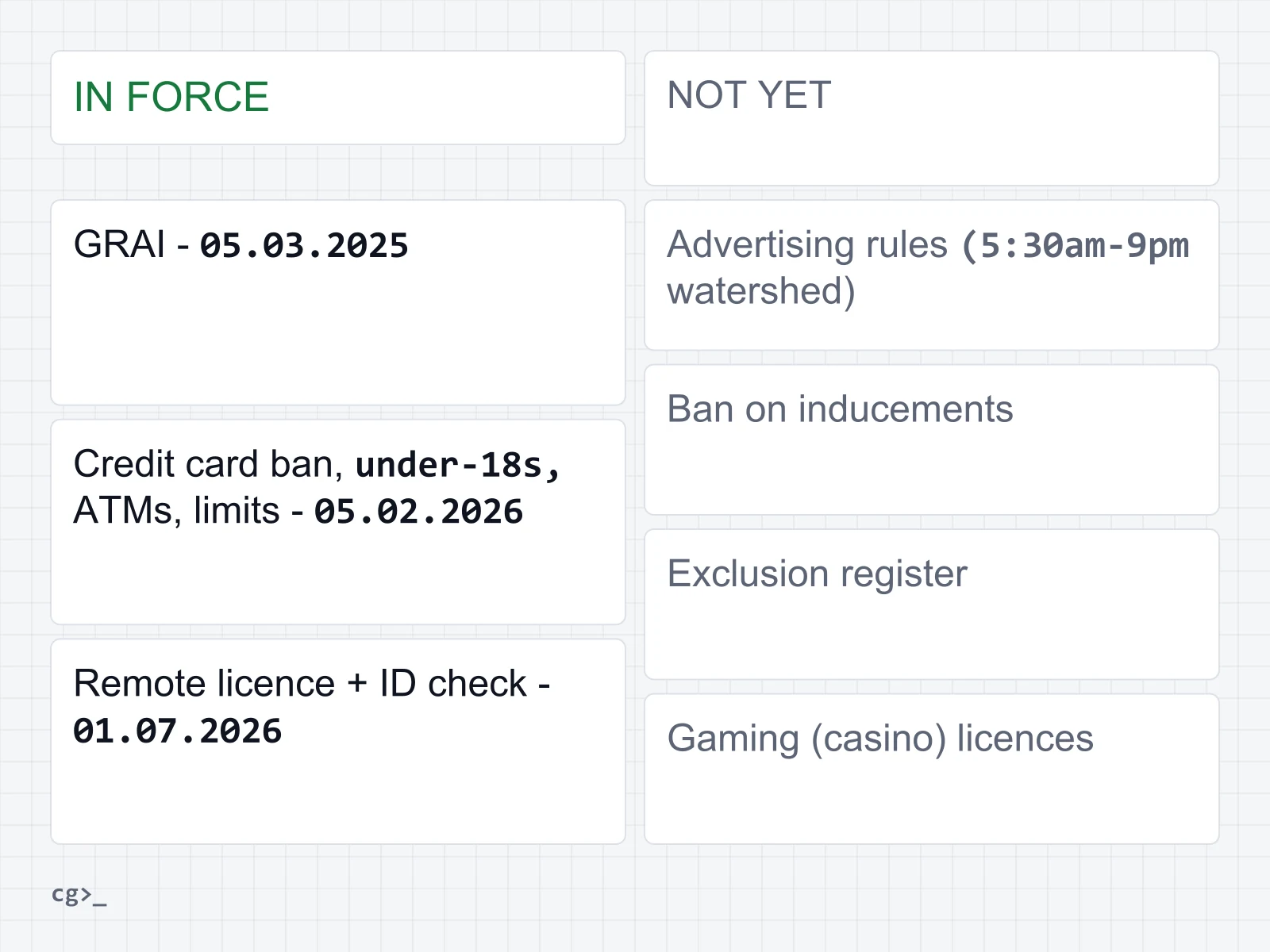
The government statement reported by SBC News on 9.11.2026 said the advertising provisions apply primarily to GRAI licensees, that work with the Office of the Attorney General is ongoing, and that it is "not possible at this juncture" to give a timeline.
What this means when you place a bet
Before you can bet
Any remote bookmaker licensed by GRAI must check who you are and how old you are before you can register, typically with photo ID and proof of address (citizensinformation.ie, edited 17.07.2026). Expect to upload documents at sign-up rather than at your first withdrawal. If a site lets you bet first and asks questions later, check whether it is on the register at all.
Paying in
A credit card will be refused. Debit cards and other methods are a matter for each operator. You must be offered the option to set limits on remote gambling; use it before your first deposit, not after a bad evening.
Offers
Free bets and sign-up offers are still legal because the inducement ban has not commenced. The Act's ban covers inducements such as free bets offered to entice gambling; how it will apply depends on commencement. Until then, read the terms, especially minimum odds, expiry and whether the free bet stake is returned.
Who you are betting with
The test is one search on grai.ie/register. Our licensed bookmakers hub shows how to read a row and what RB, RBI and IPB mean. Betting exchanges hold the RBI licence; see our exchanges hub.
Do you pay tax on winnings in Ireland?
No, not on ordinary betting winnings. Section 613 of the Taxes Consolidation Act 1997 says winnings from betting (including pool betting), lotteries, sweepstakes and games with prizes are not chargeable gains, and Revenue lists betting and lottery wins among the gains exempt from Capital Gains Tax.
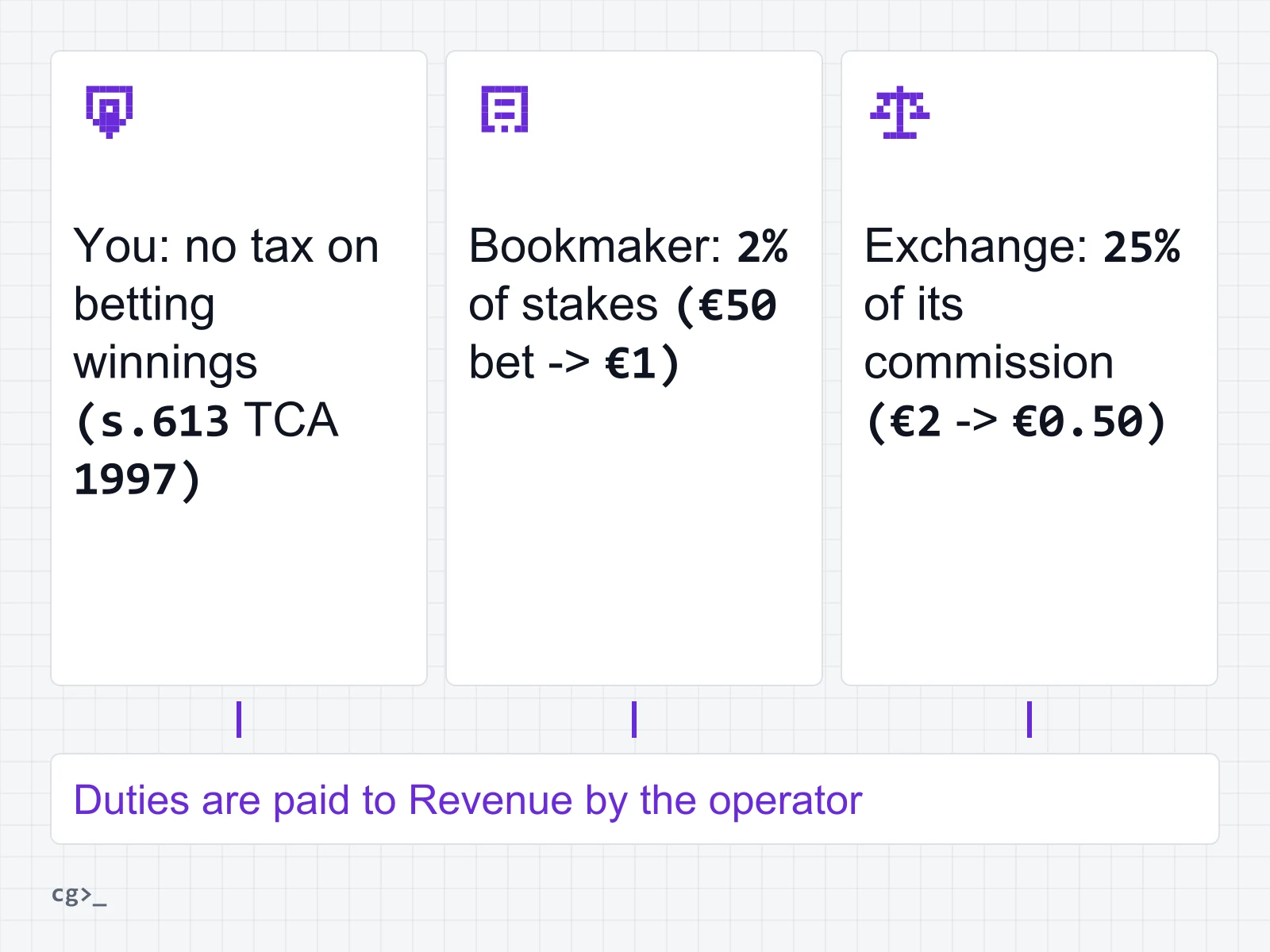
The tax is paid at the other end, by the bookmaker. Revenue's betting duty table (published 02.11.2026) gives these rates:
| Duty | Charged on | Rate |
|---|---|---|
| Betting Duty | Bets taken by a bookmaker over the counter from persons in the State | 2% |
| Remote Betting Duty | Bets taken by a bookmaker from persons in the State by remote means | 2% |
| Betting Intermediary Duty | Commission charged by a remote betting intermediary (exchange) to persons in the State | 25% |
| On-course and tote bets | - | Nil |
Worked example. You stake €50 with a licensed bookmaker. The bookmaker owes Revenue 2% of the stake: €1, win or lose. On an exchange, if you win €100 on a market and the exchange charges, say, 2% commission (€2), the exchange owes 25% of that commission: €0.50. Revenue charges both duties to the operator, not to you.
One practical point from an older Irish Times report (21.06.2008): if you ever need to explain a large sum as betting winnings, Revenue may ask for evidence. Keep your account statements. The same report notes that betting losses cannot be written off against tax. For anything beyond ordinary punting, ask Revenue or a tax adviser; we are neither.
Self-exclusion: where it stands
The Act provides for a National Gambling Exclusion Register, a single list that would let you exclude yourself from every licensee at once. As of 11.11.2026 it has not been commenced, so there is no national self-exclusion scheme to sign up to yet.
What you can do today: set limits with each operator (the option to set limits has been required since 05.02.2026), and use the operator's own account closure or time-out tools where offered. If you need to talk to someone, the GRAI help page lists the Gambling Awareness Trust national helpline, 1800 936 725, 24 hours, and Gamblers Anonymous Ireland in Dublin, 01 872 1133. More numbers are on our safer gambling page.
Read it yourself
Every date on this page comes from a document you can open. The ones worth bookmarking:
- The Act and its commencement orders on the Irish Statute Book (S.I. No. 31/2026 is the February 2026 order).
- The GRAI register at grai.ie/register, which shows each licence, its holder and its dates.
- Citizens Information's page on the law on gambling, which is written for the public and was last edited on 17.07.2026 when we read it.
- Revenue's betting duty rates page, published 02.11.2026.
Commentary from law firms and trade press is useful for context, but check the date of any commentary against the commencement orders.
What GRAI does not cover
- The National Lottery. Not regulated by GRAI; it remains under the National Lottery Act 2013.
- Online casinos. No GRAI gaming licence exists yet. See online casinos in Ireland.
Questions
When was the Gambling Regulatory Authority of Ireland set up?
GRAI was established on 5 March 2025 under the Gambling Regulation Act 2024, which the President signed on 23 October 2024.
Is the gambling advertising watershed in force?
No. As of 11.11.2026 the advertising provisions, including the 5:30am to 9pm watershed, have not been commenced, and the government said on 9.11.2026 it could not give a timeline.
Do I pay tax on betting winnings in Ireland?
No. Betting winnings are not chargeable gains under section 613 of the Taxes Consolidation Act 1997. Bookmakers pay 2% betting duty on stakes, per Revenue (published 02.11.2026).
Can I self-exclude from all Irish bookmakers at once?
Not yet. The National Gambling Exclusion Register is in the Act but had not been commenced as of 11.11.2026. You can set limits or close accounts with each operator.
Can I still use a credit card to bet?
No. The ban on credit cards for gambling has been in force since 5 February 2026 under S.I. No. 31/2026.
Does GRAI regulate the National Lottery?
No. The National Lottery is governed by the National Lottery Act 2013.
next
- /bookmakersLicensed bookmakers in Ireland: the GRAI register explainedA bookmaker taking online bets from people in Ireland has needed a GRAI licence since 1…
- /casinosOnline casinos in Ireland in 2026: what is legal and what is notAs of 11.11.2026 the GRAI register contains no gaming licence of any kind, so no online…
- /safer-gamblingSafer gambling in Ireland: warning signs, tools and where to get helpIf gambling is worrying you or someone close to you, the Gambling Awareness Trust helpline 1800…
- /exchangesBetting exchanges in Ireland: back, lay, liability and commissionA betting exchange matches your bet against another customer instead of a bookmaker and charges commission…
refs
- President of Ireland - President Higgins signs the Gambling Regulation Bill 2022 (23.10.2024)
- Houses of the Oireachtas - Gambling Regulation Bill 2022 (Act 35 of 2024), bill history
- gov.ie - Minister O'Callaghan establishes GRAI (5 March 2025)
- Irish Statute Book - S.I. No. 31/2026, Gambling Regulation Act 2024 (Commencement) Order 2026
- gov.ie - Minister Jim O'Callaghan signs order to allow GRAI to begin issuing licences
- Citizens Information - The law on gambling in Ireland (page edited 17.07.2026)
- GRAI register of licences (updated 20.10.2026, downloaded 11.11.2026)
- SBC News - Irish gov't confirms active talks on gambling ad restrictions (9.11.2026)
- GRAI - Licensing phasing (business-to-consumer licences)
- Revenue - Betting Duty rates (published 02.11.2026)
- Irish Statute Book - Taxes Consolidation Act 1997, section 613
- Revenue - What is exempt from CGT?
- The Irish Times - Tax-free winnings create that extra edge (21.06.2008)
- GRAI - Get help (read 11.11.2026)
changelog
- First published.