
Calculator - accumulator
Accumulator calculator: multiplied odds, void legs and compounding margin
An accumulator pays the product of every leg's decimal odds, and only if every leg wins. Add the legs to the calculator to see the combined price, the return and what happens if a leg is void.
checked by Casinos Geek editorial team
Multiply, do not add
Each leg's winnings roll onto the next leg as the stake. That is why the combined price is the product of the decimal odds. Convert fractional prices first: 4/5 is 1.80, 11/10 is 2.10.
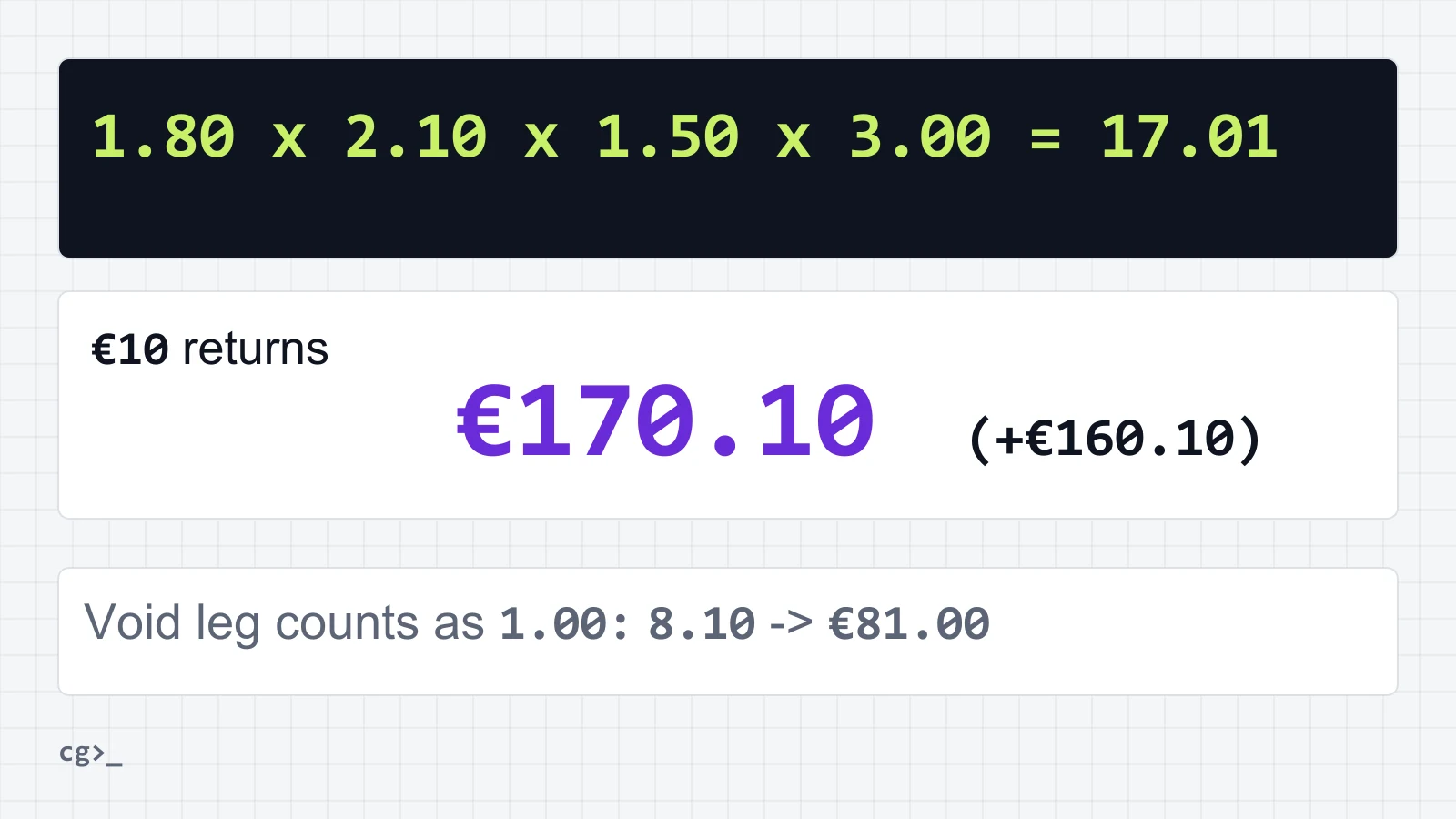
Worked example: €10 four-fold
- Legs: 1.80 x 2.10 x 1.50 x 3.00
- 1.80 x 2.10 = 3.78; x 1.50 = 5.67; x 3.00 = 17.01
- All four win: €10 x 17.01 = €170.10 returned, profit €160.10.
- Any one leg loses: €10 lost.
Void legs
If a leg is void, for example a non-runner or a postponed match, it is usually settled at odds of 1.00, and the accumulator drops one fold. The exact rule is in each bookmaker's terms, so check them.
Same four-fold, the 2.10 leg is void: 1.80 x 1.50 x 3.00 = 8.10. Return €81.00, now a treble.
If the void leg is a horse race and the withdrawal happens after your bet, a Rule 4 deduction can apply to the remaining runners in that race. The each-way page explains how. In a football accumulator, a match abandoned or postponed is treated by the bookmaker's own rules, which set how long it waits before voiding the leg.
What the combined price says about the chance
The combined price converts to an implied probability like any other. 17.01 implies 1 / 17.01 = 5.88%, about one win in 17 attempts if the prices were fair. They are not fair, which is the next section.
Why the margin compounds
Each leg carries the bookmaker's margin, and multiplying the odds multiplies the margin too. The example below is a worked model, not any bookmaker's actual prices.
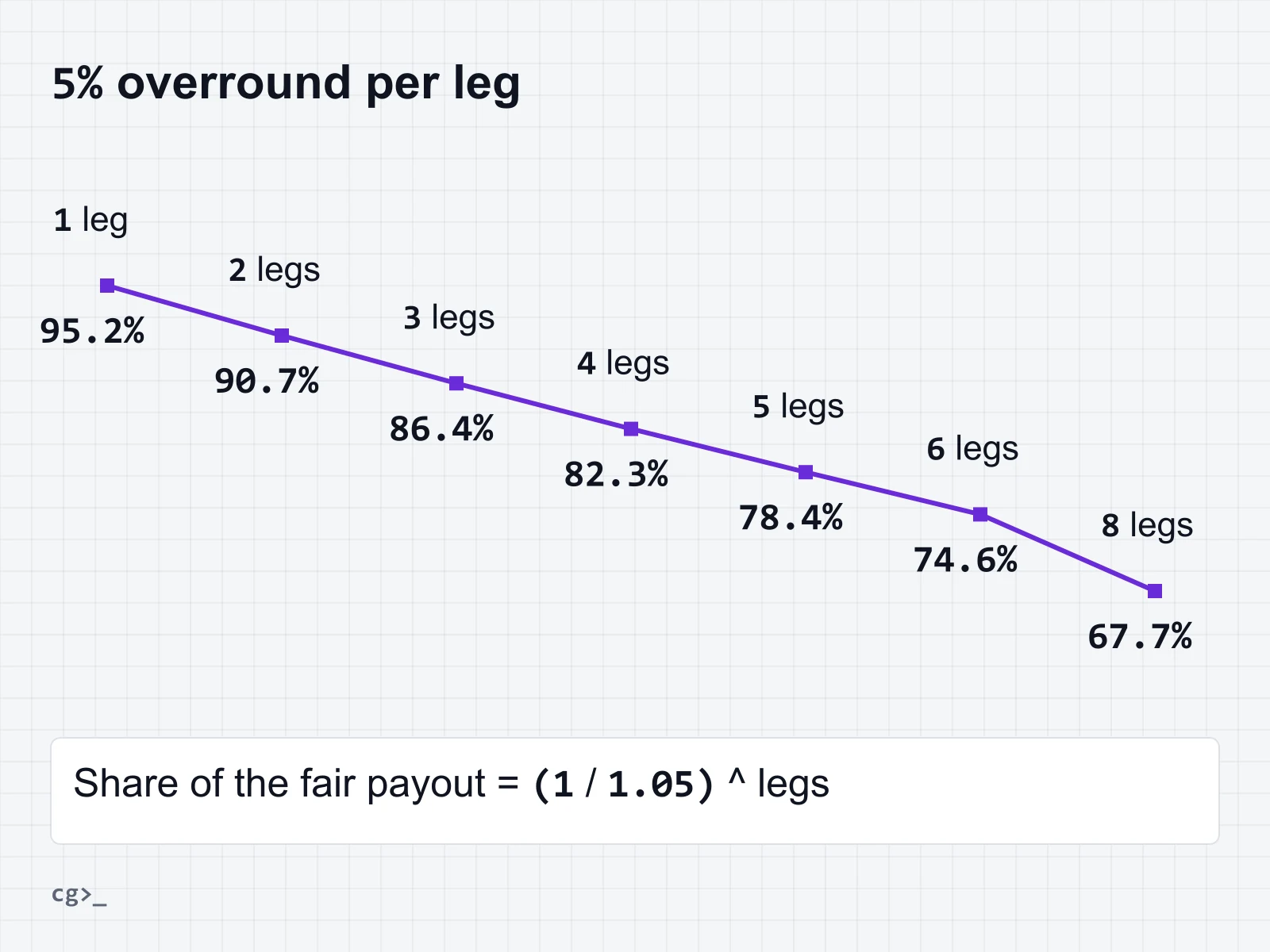
Five legs, each a true 50/50, 5% overround per leg
- Fair odds per leg: 2.00. With a 5% overround: 2.00 / 1.05 = 1.905.
- Fair five-fold: 2.00^5 = 32.00.
- Bookmaker five-fold: 1.905^5 = 25.07.
- You are paid 25.07 / 32.00 = 78.4% of the fair price, the same as 1.05^5 = 1.276, an overround of 27.6% on the whole bet.
One leg at 5% costs you about 4.8% of the fair payout. Five legs cost about 21.6%. The more legs, the more margin you pay. The arithmetic for a single market is on the odds calculator page.
| Legs at 5% overround each | Share of the fair payout you receive |
|---|---|
| 1 | 95.2% |
| 2 | 90.7% |
| 3 | 86.4% |
| 4 | 82.3% |
| 5 | 78.4% |
| 6 | 74.6% |
| 8 | 67.7% |
Share = (1 / 1.05) to the power of the number of legs. Bookmakers' actual margins differ by market; work yours out on the odds calculator from the prices you see.
Related legs
The multiplication assumes the legs are independent. Two outcomes from the same match, such as a team winning and that match having over 2.5 goals, are not. Bookmakers usually refuse to combine related outcomes in a normal accumulator and price them separately as a same-game bet, with its own margin. The calculator here treats every leg as independent; do not use it for same-game combinations.
Doubles, trebles and full covers
With several selections you can bet every combination instead of one accumulator, so one loser does not sink the whole bet. The count of combinations is n choose k.
| Selections | Doubles | Trebles | Four-folds | Five-folds | Total bets, no singles |
|---|---|---|---|---|---|
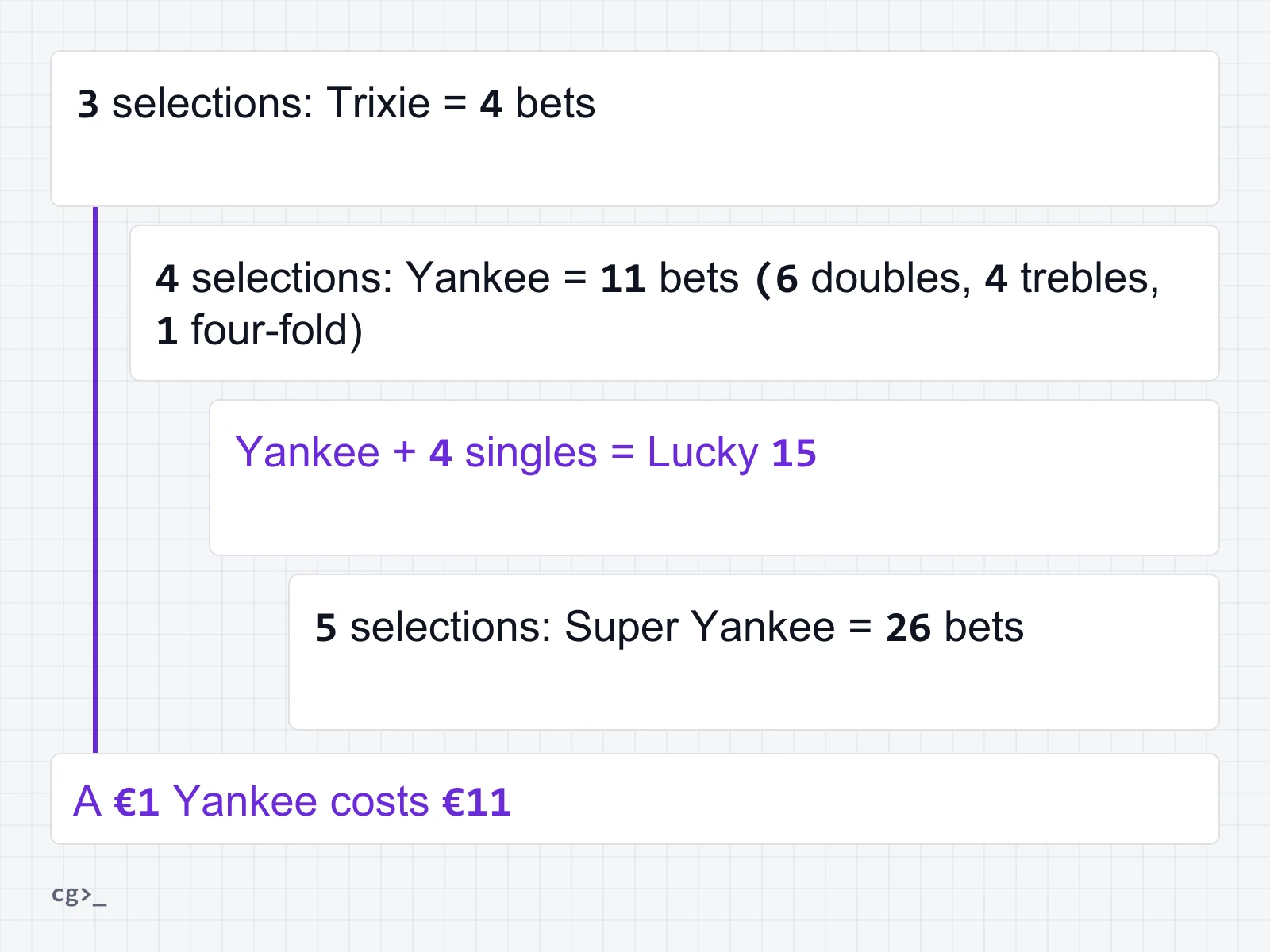
| 3 | 3 | 1 | - | - | 4 (Trixie) |
| 4 | 6 | 4 | 1 | - | 11 (Yankee) |
| 5 | 10 | 10 | 5 | 1 | 26 (Super Yankee) |
Each combination is a separate stake: a €1 Yankee costs €11. Adding the four singles to a Yankee makes 15 bets, known as a Lucky 15. Full covers spread the risk but also multiply the outlay and the margin you pay.
For each-way legs, both parts are combined separately; see the each-way calculator.
Questions
How is accumulator payout calculated?
Multiply the decimal odds of all legs, then multiply by the stake. €10 at 1.80, 2.10, 1.50 and 3.00 returns €170.10.
What happens if one leg is void?
It is usually settled at 1.00 and the bet drops a fold. Check the bookmaker's rules.
How many bets are in a Yankee?
11: six doubles, four trebles and one four-fold. A €1 Yankee costs €11.
Why do accumulators favour the bookmaker?
The margin multiplies with each leg. At 5% per leg, a five-fold pays about 78% of the fair price.
next
- /calculatorsOdds calculator and converter: decimal, fractional, American, probabilityEnter a price in any format and the calculator gives the other two formats, the implied…
- /calculators/each-wayEach-way calculator: win part, place part and place termsAn each-way bet is two bets of equal stake: one on the horse to win, one…
refs
changelog
- First published.